

Keeping in mind that I’m demonstrably terrible at forecasting — https://solresol.substack.com/p/im-in-the-bottom-1-of-ai-prophets — here is my best estimate of the capability cascade of AI. I’ve thrown in some predictions which probably sound absurd, but remember that past performance has shown that I am consistently too conservative in my predictions. Reality will probably catch up faster than what I’m expecting here.
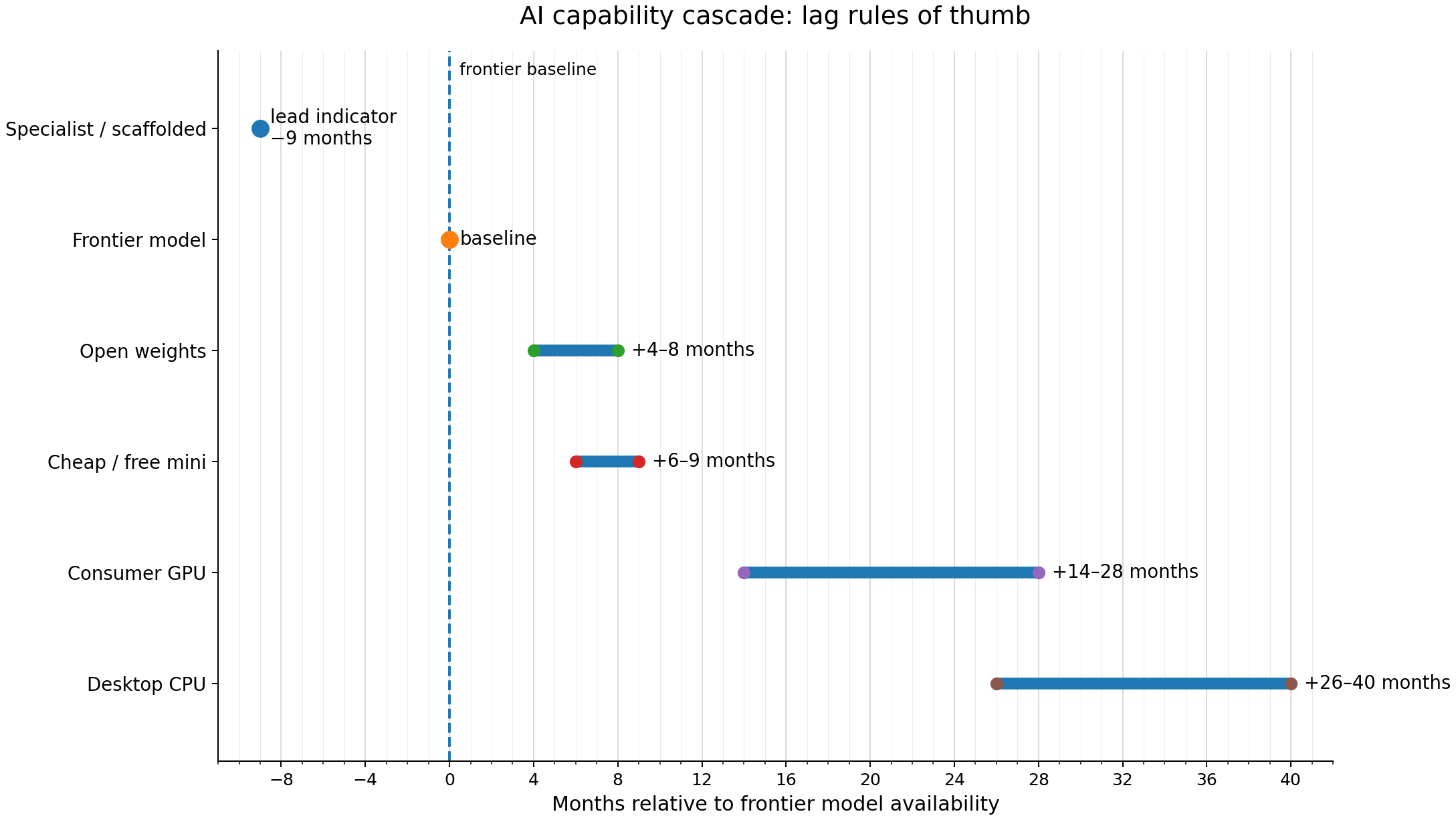
Not everyone gets access to all AI capabilities at the same time. They appear first in specialist, scaffolded systems; then they reach frontier general models; then open-weight models; then cheap/free models; then local GPUs; then ordinary office hardware. If you watch the specialist systems now, you can forecast what everyone else will have months or years later. At least, that’s the plan.
Caveat: I’m still thinking about https://solresol.substack.com/p/diffusion-of-technology where all the things that people wanted AI to do were already available; so availability on its own is not the whole story — you can have access to AI tools for free and still not be using it. But let’s ignore that for now, and try to map out the capability timeline.
9 months from specialised to frontier
If you carefully provide supporting infrastructure, tooling, and carefully designed prompts, you can get outputs that are about equivalent to what you get from a generic prompt nine months later.
Claude started getting really good at programming at the beginning of May 2025, but I had some students working on interactive shells with tools that provided a vaguely similar kind of experience around the beginning of August 2024, roughly nine months earlier.
By adding carefully tuned grammar and form recognisers, we can get quite a lot better results translating Stephanos than if we just use a generic “translate this” prompt. (There are various metrics for measuring how good a computerised translation is compared to a human translation, so this is both a quantitative and qualitative observation.) But what I can also do is track the generic “translate this” prompts from (say) GPT-5.5 to Fable 5 that were released about 6 weeks apart and look at how they went. Then I can extrapolate that improvement and ask “when would a generic ‘translate this’ give me as good a translation as our carefully tuned translators?” It works out at about 210 days (which is only 7 months) for most metrics, with one weird outlier saying 400 days (a bit over 13 months). Weighting them, I get about 9 months.
The folks at Metaculus have tried to measure the phenomenon very carefully around forecasting. This is what they said: https://www.metaculus.com/notebooks/43363/ai-forecasting-in-2026/
Good scaffolding is worth 9 months of base model progress: in the Fall 2025 bot tournament, the top five scaffolded bots beat their non-scaffolded baseline by 5 to 11 peer-score points per question. Frontier base models are getting better at about 0.9pts/month which makes good scaffolding worth around 9 months of base model progress.
Implications
If your business model is that you provide infrastructure to make AI solve some problem that AI can’t do right now (e.g. run a legal case, prepare a tax return, etc.), then your business will probably be irrelevant in about 9 months. I don’t mean that to be discouraging. It’s not nothing: you can make some profit in that time. Maybe you discard it and then move on to another industry. Or maybe you build up a lot of experience which then gets you a better job in your industry because you’ve already lived through the AI revolution in your industry.
Building a scaffolding-of-AI business sounds like it should be repeatable for a few rounds yet. Get the industry experts together. Record what they talk about and transcribe it. Turn that into a bunch of Claude skills and integrate it with whatever the dominant tools in that industry are.
Or, in your existing job, go and interview all the knowledgeable people about every different process and turn it into an in-house Claude skills library (which will also work in Codex and other tools), and that should give you a 9 month lead on your competitors. Presumably if you keep doing that, you stay 9 months ahead.
If you want to see what power users of AI will be able to do in 9 month’s time, watch what the specialist companies can offer.
Predictions
AI Superforecasters. It’s July 2026, and specialised AI superforecasters are sort-of available now. Sort-of: it doesn’t seem like any are available for signing up by the general public. In any case, they seem to be busily making money on Kalshi, PredictIt and the stock-market.

Therefore we would expect that the AI models that the frontier model companies (probably OpenAI, Anthropic, Google) release in April 2027 will be on-par with human superforecasters. If you want to know whether your business will succeed, or whether a drug is likely to work, you’ll be able to ask your AI about it and get a quantified probability.
Stock picking. I was a little blindsided by people saying that their scaffolded models are now beating the market picking stocks. There’s this arxiv paper that backs it up, sort of - https://arxiv.org/abs/2603.19944. Let’s say we believe it and that’s the equivalent of “scaffolded”: think about the implications of it. In this (Australian) financial year, we should see that a Pro subscription to ChatGPT will pay itself off by running your portfolio for you. What does that mean for professional investors?
Public service announcement. Don’t listen to me for investment advice either. I bought Freelancer stocks at 65c per share during Covid using the logic that companies would get used to having remote staff doing work, and then the inexorability of cheaper offshore labour substituting for local labour would mean that solutions for efficiently paying and managing offshore labour would become valuable. Did I accurately forecast that? If they can turn around and grow at better than 6% above inflation for the next 30 years I might be able to sell at a profit. The problem was that AI came along. The bigger problem was — as someone in AI at the time — that I should have seen this coming.)
I’m already at a level of investment skill that I would be better of using an AI bot. (Actually, I would be better off than I am now just using a rock with “buy index funds” painted on it. Even using a Roman augur would probably be an improvement.)
AI in April 2027 won’t know all the answers (stocks, businesses, drugs) of course, but it will be able to say “25% chance of success” or “90% chance of success” and then you can figure out whether that’s worth it for you. Or you could tell it your risk/reward ratios and/or capital depth and ChatGPT will do a better job than most humans at managing your wealth and business investments.
SignalStorm game. AI forecasting is an alien way of thinking about the state of the world, so I made a fun game out of it. My prediction: a lot of people will play that game because there doesn’t seem to be another game that teaches that same idea.
Unashamed advertisement for my own work
https://signalstorm.industrial-linguistics.com/
A typical first game takes about an hour, and often (not always) the AI doing careful analysis wins. A lightning game is about 10-15 minutes, and humans reacting quickly or the “Delegate everything to AI” crowd often wins. It works best in groups of about 3-10. It’s also multilingual and has been play-tested by a cohort of Japanese business executives who got surprisingly rowdy playing it.
If you want to support me, buy the overpriced physical card deck on the site. If you are a cheapskate just print out the card deck on thick paper and cut it up.
4-8 months from frontier to open weights
Epoch AI’s May 2026 estimate: since January 2026, the best open-weight models have lagged the closed frontier by an average of four months. https://epoch.ai/data-insights/open-closed-eci-gap . The UK AI Security Institute summarises the current gap as four to eight months. Open models seem to be closer on mainstream public benchmarks but further behind on longer-horizon agentic work.
Ethan Mollick put together this chart which suggested a 3 month gap:
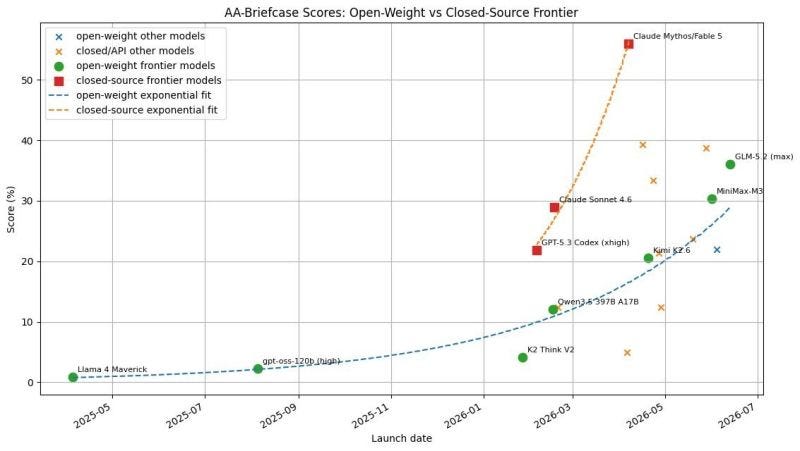
It’s mostly the Chinese AI companies that release open-weight models: DeepSeek, Kimi, GLM and Qwen. These are models where you can use them as much as you like without paying per token. At least that’s the theory. In reality, they’re so large in their non-distilled form that they can only run on enormously expensive specialised hardware. By the time you depreciate the cost of that hardware over any reasonable length of time and look at the number of tokens that you can generate from those models in that time, the tokens don’t look free anymore.
But it is a stepping stone, particularly to the point where consumers can easily run something on their own hardware, and it’s also a measure of where the Chinese market is. If a scaffolded technology becomes available in July 2026, then people paying for premium subscriptions from the American majors will get that in April 2027, and Chinese consumers will see it somewhere between August 2027 and December 2027.
Implications
The frontier model providers have to make all their profits from any given model within four to eight months. This is a brutal cadence. Train and deploy and hope.
Predictions
Chinese stocks will still be irrationally mispriced even towards the end of next year (i.e. well into 2027). But by the beginning of 2028, everyone in China will have access to use AI to run their investment portfolios, and stock pricing should become more sensible then. Chinese financial media would probably describe this as “the structural value revaluation round” — 一轮结构性价值重估 and it will be the topic of constant discussion in media and government.
This 4-8 month rule lets us predict when bio-risk and cyber warfare problems are going to become most acute. If we assume that Mythos is functionally like a scaffolded application then frontier models from OpenAI and Google will probably have similar capabilities by the end of this year (2026). They could be gate-kept by the US government if they wanted to. But another four to eight months after that, i.e., April to August 2027, is when we would start seeing open-weight models that can do cyber warfare or advanced biological research. And because the weights are open, there’s no realistic way for any government to keep that under control. This will be the most dangerous time for terrorist threats.
6-9 months from frontier to cheap / mini models (very roughly 1-2 months behind the open weight models)
I can’t justify this number much better than “it feels about right”. There are arguments that the timeframe might be shorter: GPT‑5.4 mini (March 2026) is about on par with GPT‑5.2 (December 2025), which would say 3 months. Anthropic described Haiku 4.5 as equivalent to Sonnet 4 (5 month gap). I think there’s a bit of cherrypicking there though. I did use gpt-5.2 for coding (and it wrote some really good theorems for my PhD thesis); I’m not that confident of gpt-5.4-mini being able to do that. But gpt-5.4-mini is definitely worlds better than gpt-4o, so the mini models do eventually beat their predecessor frontier models.
Most people interact with the free models from ChatGPT or Anthropic, which are often powered by mini models. To an average member of the public AI is whatever the free services offer. So to most people, we’re just entering the agentic AI era, and having agents that you can give a goal to and have them go and complete tasks on a website is still something new and unusual.
Tasks like “analyse this spreadsheet”, “explain this screenshot”, “compare current sources”, “generate an image”, “summarise this PDF”, or “help me debug this small program” are now free-tier activities rather than paid-frontier activities.
I saw this play out just now in a conversation between Anna Jacobson and Kieran Snyder:
Anna Jacobson said:
Specifically: task decomposition - the ability to break a complex workflow into well-bounded atomic units and assign each to the executor who will handle it best - whether that executor is human or AI. I'm convinced this is one of the keys to AI transformation right now.
Kieran Snyder replied:
I would have said this 6 months ago, but not now.
I've become much more of a model maximalist. What I am seeing of truly AI-pilled organizations is 1. defining clear KPIs and current systems of use, 2. deploying an AI (with guardrails) and pointing it out the outcome and systems, and 3. letting the AI build "workflows" on the fly and self-correct in pursuit of the goal.
Easier in small places than enterprise, easier in new systems than legacy ones. But there is a clear divide between the before and after approaches to AI transformation, with the "after" AI-pilled state of operations showing up much faster than I expected.
Implications
If you make money by teaching people “how to use AI” for beginners, you can calibrate your curriculum by looking at what was new and interesting about 6-9 months ago.
Students don’t typically pay for their AI. The sophisticated ones do, but teachers and academics generally aren’t even trying to catch the sophisticated ones.
Most people I know who still think that catching academic integrity violations with AI is possible are only dimly aware of what the frontier can do, because most AI usage in schools and universities is not from sophisticated frontier models.
I was talking to a colleague who offered an amnesty to her class: admit your AI usage and you can resubmit properly for a small penalty; if you don’t admit it and I can prove it, you fail the subject. More than 50% of students who requested amnesty were not on her suspicious list.
One thing I’m wondering about is whether the USA government will want to keep restrictions on frontier models. Now that Fable 5 is available again I’m less worried, but I was wondering whether the rest of the world was going to have to survive on distilled “mini” or “nano” models. That would have put us at a permanent half-year-to-full-year disadvantage compared to American companies.
Predictions
At the end of 2026 / beginning of 2027, we’ll be seeing talk about goal setting of AI bots in the general public, rather than among the AI-centric technorati. Keeping folders with your work goals and relevant information for your bot to work autonomously will be the hot new thing to do.
The cliff for portfolio managers is 15-18 months away from now, somewhere around the last quarter of 2027 to the beginning of 2028. That’s when simple extrapolation would say that humans won’t be able to compete with free tier models.
The legal system is in for a shock early next year (2027). I think it’s possible to argue a pretty good case now with Fable 5 and gpt-5.5, at least for some mundane matters. It’s not possible to run a good case using gpt-5.4-mini or haiku-4.5, so most AI-argued cases at the moment are pretty terribly run — they are a burden on the court system, but don’t really change the profession much. But the free tier models of March 2027 will probably run a pretty good case for prosecution or defence. (We’ll be sort of back in the era of the educated Greeks and Romans, where everyone who was educated could and would argue their case in court.) If we don’t want to promote a lot of judges in a hurry, we’ll need to set up more intermediary-level processes (e.g. like commission-style hearings with a commissioner instead of a judge) for the kinds of cases that less-wealthy litigants will want to bring.
10-20 months from open weights to consumer GPUs (14-28 months behind frontier)
A model can have open weights and still be impractical for a normal person to run. A giant mixture-of-experts model might be “open” in the sense that you can download the weights, but will usually require a rack of GPUs that start at $20,000 each.
But models can be distilled and quantised, and consumer-grade GPUs get better. If you are a gamer, you probably have a better rig than most, and the models you can run today like Gemma 4 31B are certainly better than gpt-4o
A gaming PC gets last year’s frontier features after roughly 14-28 months later, with something 16 months as the optimistic case; it gets last year’s frontier dependability rather later.
Very security conscious organisations (military, political, etc.) might find this the convenient point to track. They might be buying hardware that’s a bit more expensive than they really want to buy, but this gives complete control, complete security and insignificant ongoing costs after that expensive purchase.
Implications
This is where it becomes impossible to police. Even places like North Korea can get hold of PCs with GPUs in them (you can smuggle something in a suitcase out of a country). Getting hold of distilled open weight models is trivial; there will always be a BitTorrent feed somewhere, even if we shut down Hugging Face.
That suggests a Mythos class AI that can run on a consumer GPU should arrive in 2028 (but maybe as late as 2029). We had really better have our cybersecurity in place by then, because every nation state or barely-competent rogue hacker group will have a machine that can tear apart any pre-2026 software. (Pre-2026 we had no practical and reliable way of writing software that was reliably secure from attacks for the most part: OpenBSD/openssh show that it was possible, but only just.)
Predictions
IoT-armageddon 2028 is going to be a very bad year for IoT devices and consumer-grade networking equipment. Nothing built before 2026 will be safe. Every ISP will have to upgrade their consumer customers’ routers and firewalls.
12 months from consumer GPUs to desktop CPU (26-40 months behind frontier)
Corporate desktops don’t generally have powerful GPUs (although they can), likewise corporate laptops. Companies tend to keep their end-user hardware for a while. But eventually models get small enough, and hardware upgrades catch up enough that they meet in the middle.
If you work in a typical office, dedicating 32GB RAM to a model today is a luxury that is out of reach. (In any case, most corporates would prefer to have centralised AI infrastructure for governance and reporting reasons anyway.) If you work at a dinosaur organisation (of which I have many such clients) that forbids AI and also has a centralised AI plan that is still not executed, you still can run AI models locally. The dirtiest hack is to run them in the browser so that you don’t even install anything: https://localai.industrial-linguistics.com/ for example.
General confusion about using AI being equal to data leaving your computer has bedevilled many semi-competent cybersecurity teams. If gpt-4 turbo was capable of doing some task — and it was, it was pretty amazing back in 2023 — be aware you can now run something pretty close to that (Gemma 4 E2B) on even the clunkiest of corporate desktops.
Implications
In 2029 (probably around September to November) we will all (and genuinely, everyone from corporate office worker to aid worker in the field) have access to tools that are equivalent to Fable 5 today.
White collar work cannot stay the same.
Predictions
Singularity This is the point beyond which we can’t predict. When every member of society has a capable AI at their disposal, every institution is affected.
Addendum
I was going to stop there, but how similar is this to child development?
GitHub Copilot launched its technical preview at the end of June 2021, which was a scaffolded pair programmer, based on a customised gpt-3. That’s five years ago. That’s not a bad starting point.
Some people are seeing the state of AI up to 49 months ahead of others.
Picture two children: one has just turned 5 years old. They are heading off to school, have internalised the grammar of their native language, are probably reading books, and perhaps showing some precocious skills: maybe you can see that they are good at maths or have a natural talent for playing the violin. Watching them play, you can maybe see that they are likely to be a top engineer, or a writer or an actor.
The other child has not yet turned 1 (they are 49 months younger). They are probably still working on crawling. They might very possibly have a few words of vocabulary.
Most of the world’s population — even in the developed world — are looking at the child who is not yet 1 and wondering how people can be so confident of a child’s future direction. The people looking at the 5 year old child are wondering how the others can’t see what’s happening and where the future is headed.
Likewise with AI. If you look at the technology with 5 years of capability development, it’s obvious where it’s going. If your experience is only with the trailing end (less than 1 year of actual capability) — which is all that most people in the world have experienced — then it all looks like hype and bubble.
Interesting article, I just discovered your substack with it and is a great surprise! One consideration: have you tought of the consequences of having consumer grade hardware running fable-level models on the world of gaming (or models of that level almost for free, which will happen soon given your model)?
It is a field virtually untouched by LLMs until now, at least in the field of AAA games, I think mainly for price reasons, but with an enormous potential given by the possibility of real agentic npcs with natural language interactions with the player, a big step to the creation of real "world simulations"